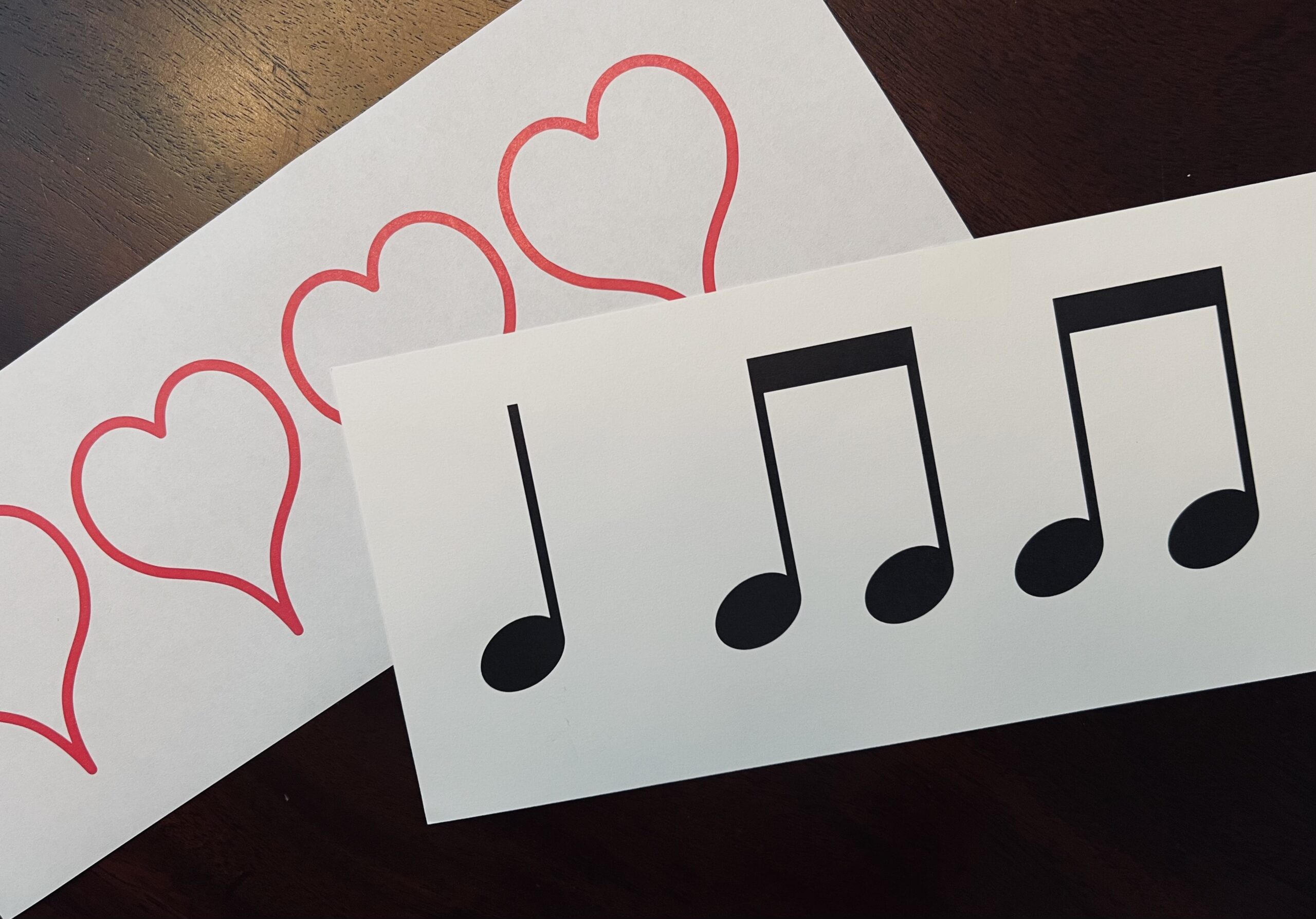
This week I’m kicking off a new series called ‘Musical Mondays’. Each Monday we’ll tackle a musical concept and I’ll be your guide on how to model these ideas for your students. Remember that my #1 goal at Morning Basket Music is to make it easy for anybody to teach music to their kids (I’m looking at you, busy homeschool mom).
Let’s begin by tackling this question: How do I teach the difference between beat versus rhythm?
What you’ll find in this blog post:
- Explanation of steady beat vs. rhythm
- Demonstration of how you can show the difference to young kids
- Inspiration of new ideas to try in your teaching
What is the difference between beat and rhythm?
Back in college when I began my first student teaching assignment, I had a wonderful mentor who gave this short, simple explanation to her kindergarteners. This is a literal, “Explain to me like I’m five.”
The steady beat in music is like your heartbeat; it beats over, and over, and over. It never stops and it never changes.
The rhythm of the music is found in the words. Each word has its own rhythm. To figure it out, I like to tell kids to speak the words and clap on each syllable. For example, clap the syllables of the word “wa-ter-mel-on” and you’ll notice there are four claps. But clap the syllables of the word “grapes” and you’ll find that there’s only one clap. Watermelon and grapes have different rhythms.
How to model this for your students
A great way to demonstrate the difference is by using a nursery rhyme that kids already know. For example, “Jack and Jill went up the hill to fetch a pail of water. Jack fell down and broke his crown and Jill came tumbling after.”
You can show the steady beat by patting or tapping along at the same, unchanging speed.
Then model the rhythm of the words by clapping the syllables while speaking the rhyme out loud. Kids will likely notice that some claps come fast and some come slow; this is the rhythm!
Make it a game by having one person (parent/teacher) demonstrate the steady beat through marching while the other kid(s) demonstrate the rhythm of the words by clapping syllables. You can also play a fun game where everyone speaks the rhyme together as a group, but at any moment the teacher can say “Switch!” and you have to change between showing steady beat or rhythm.
Top 3 ways to practice steady beat with kids
Keep in mind that it’s always a good idea to practice/reinforce steady beat with kids of all ages. Why? Because identifying the beat in a piece of music is a foundational skill. Once a child masters this, it will become much easier for them to develop rhythm skills later on. Here’s how you can make it fun!
Percussion Instruments
Drums are a great option for practicing steady beat because we typically associate those with marching to a beat. But remember, a percussion instrument is anything you can tap, shake, or scrape, so use what you’ve got! Kids can even make steady beat motions without an instrument by doing body percussion: clapping hands, snapping fingers, patting their laps, or stomping feet.
Scarves
A scarf is a fun prop that helps kids “see” the beat as they wave it back and forth. You can find an inexpensive set of chiffon scarves on Amazon and they are well worth the investment. As a teacher, I used these things for everything (parachute games, dancing, musical form, you name it). For this activity, turn on some music and have kids wave the scarf left and right to the beat.
Bounce a ball
This is one of my favorites for building coordination! Turn on some music and challenge kids to bounce a ball in place, right on the beat. For younger kids, consider using a beach ball or playground ball that’s easier to control. Older kids (with better coordination) can be challenged by bouncing a tennis ball to the beat.
When choosing a recording to play, I love to use anything by the American composer John Philip Sousa. He wrote many pieces for marching bands and they all typically have a strong pulse in the background that’s easy to identify. You can use just about any favorite music, but make sure that the steady beat is obvious.
Want to find out more about beat versus rhythm, and how to teach it to kids? Check out this YouTube video from Morning Basket Music, and see exactly how I model it.