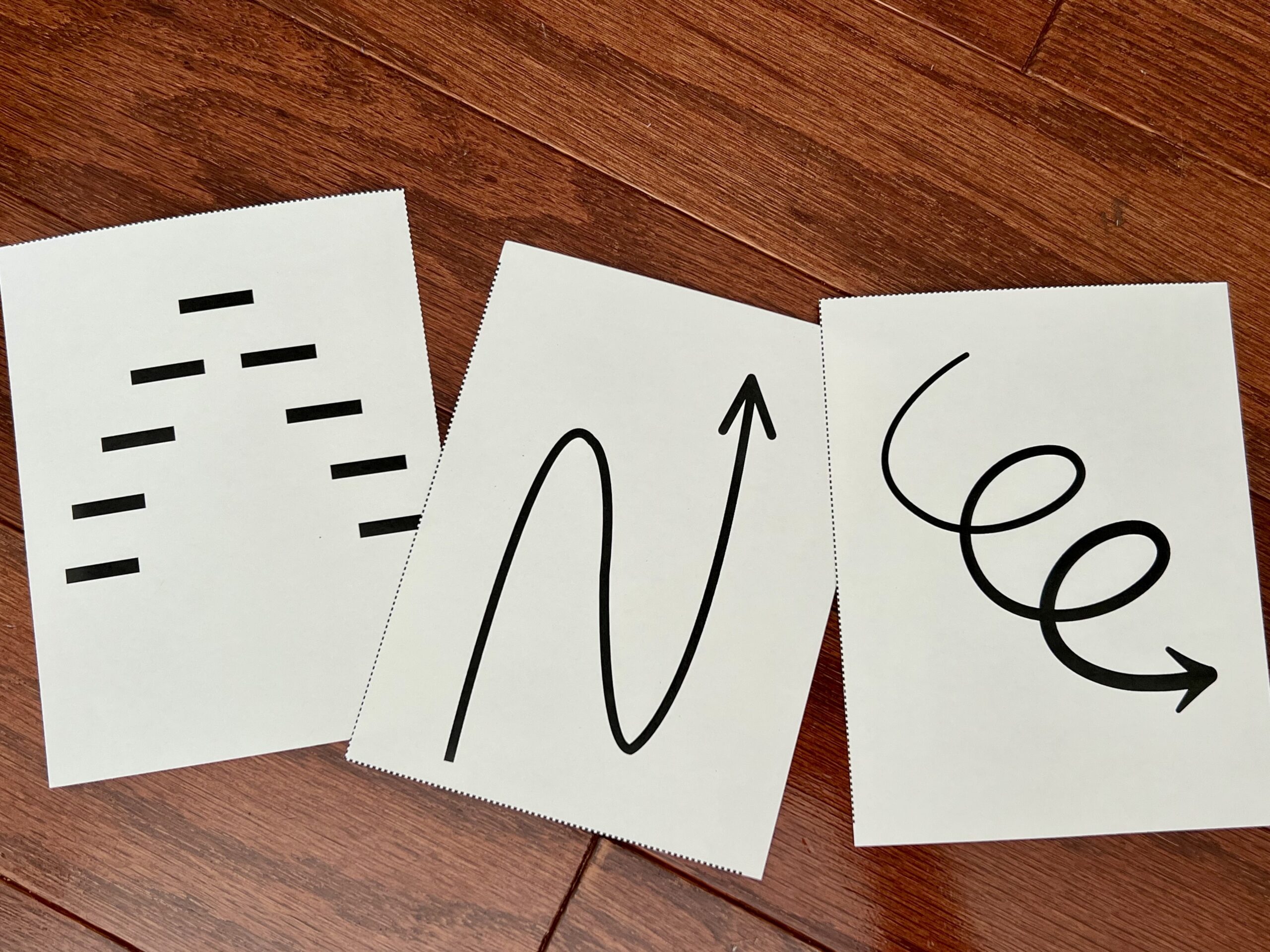
What should you do if you’re working with a child who struggles to match pitch, or like many students, someone who feels hesitant to sing in front of others? Vocal Shape Cards are a great tool to help solve these problems and get kids to explore pitch in a fun, comfortable way.
What you’ll find in this blog post:
- Where to find pitch exploration cards
- How to use these cards
- Key benefits of this pitch activity
Where do I get cards for pitch exploration?
You can find lots of good options online if you search either “vocal shape cards” or “vocal exploration cards”. Many of my favorite sets have come from Teacher Pay Teacher. This set below is found in the Morning Basket Music curriculum.
But the good news is – whether you’re short on time or just don’t feel like printing something – these cards are also super easy to make! You don’t have to be an amazing artist to draw various shapes/lines on a blank piece of paper and create your own set of pitch exploration cards. In fact, let your kids help!
How to use vocal shape cards
Each card will have some type of shape or line drawn on it. The idea is for students to trace the shape with their finger while simultaneously using their voice to match the direction of the line.
For example, if a card shows a line that goes up, the student would slide their voice from a low pitch to a high pitch. If a card shows a zigzag pattern, the student would make their voice go up and down quickly to follow along.
Here are some tips for success:
Practice one card at a time. Start with simpler shapes (a straight line, a curve) before moving to more complex ones (zigzags, spirals).
Model it first! Let kids hear you do it before asking them to try. Kids are much more likely to participate if they see you being silly and making funny sounds with your voice first.
There’s no right or wrong sound. The point is to explore and experiment with their voice, not to hit specific notes. Any vocal sound works — humming, sliding, using “oooh” or “ahh” or any silly sound they want.
Key benefits of pitch exploration
- It builds awareness of high vs. low pitch in a hands-on, visual way. Kids can literally see and trace where the sound should go.
- It removes the pressure of “singing a song” for kids who are shy or self-conscious. Since there are no words or melodies to memorize, it feels more like a game (trace the shape and make a sound) rather than a performance.
- It strengthens the connection between what kids hear in their head and what comes out of their voice (this is called audiation — the ability to hear music internally before you sing it out loud).
- Students are much more comfortable practicing their singing voices when it just feels like a game. Vocal shape cards can remove a lot of the hesitation for shy kids.
If you’d like to see how I demonstrate pitch exploration with kids, check out this YouTube video from Morning Basket Music.