What’s included in the preview unit?
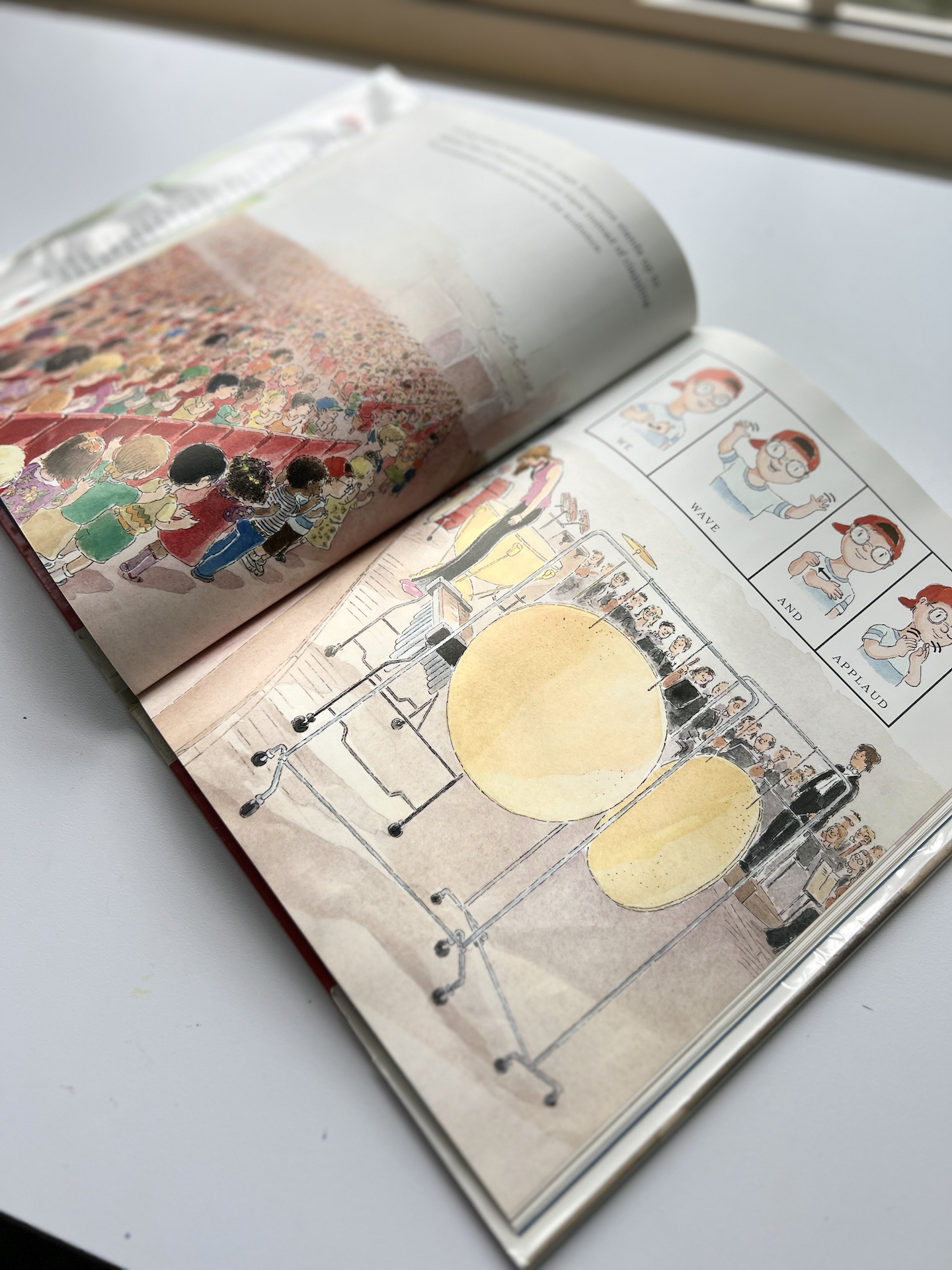
As you’re learning more about the Morning Basket Music curriculum, I’d love to give you a peek inside the preview unit. Moses Goes to a Concert is a wonderful story that teaches kids empathy and introduces American Sign Language. They will hear about instruments from the percussion family, and there’s a fun science experiment you can do at the end. Follow along as we explore each day of the free unit!
Day 1: Read the book together
The story follows a young boy named Moses and his group of classmates, who are all deaf, to their first orchestra field trip. Invite your kids to imagine being part of that experience.
“How could a person who can’t hear be able to enjoy a musical concert?”
Readers may notice a few unusual things in the story: the section of percussion instruments is located at the front of the stage (in typical setups it would be near the very back), and the percussionist is only wearing socks on her feet! Oh, and also the teacher brought along a large bag of balloons. Hmmmm…I wonder what’s going on…I won’t give any spoilers here, you’ll just have to read it for yourself. ☺️
On each page of the book, you’ll find select words where kids can practice ASL to help tell the story.
Day 2: Make a homemade percussion instrument
Get ready to go hunting around the house and see what materials you can find to make your own percussion instrument. Kids learn that a percussion instrument is anything you can hit, shake, or scrape.
Empty bottles that can be filled with rice or beans? Maracas.
Plastic buckets or bowls that can be tapped with wooden spoons? Drums.
Metal pot lids you can bang together (maybe outside)? Cymbals.
There are so many creative ways to make your own instrument and I’ve outlined several ideas on Day Two of the preview unit.
Day 3: Sing and play along with a variety of percussion
Now that you’ve put together some homemade instruments, it’s time to sing about the percussion family. Here’s a little sample, sung to the tune of “The Addams Family.”
Verse 1:
Let’s play the drum (tap, tap)
Let’s play the drum (tap, tap)
Let’s play the drum, let’s play the drum, let’s play the drum. (tap, tap) You shake them or you scrape them, you hit them when you play them. These instruments are from the – Percussion family.
Kids get to accompany the song with their homemade instruments, any rhythm instruments you may already own, or even perform their own body percussion such as: clapping, patting, snapping, etc.
Day 4: Listen to a recording and discuss questions
Check out this neat performance on YouTube of the piece “Cyclone”, by Jim Casella. Students will get an up-close look at many of the instruments mentioned in Moses’ story. Then, take some time to discuss what the listeners thought of the piece.
Example questions:
If you were at a live performance of this piece, where would you want to sit and why? (maybe near the back – it’s too loud, or near the front to get a good view of the instruments)
If you heard this song as background music in a movie, what would be happening in the scene?
Day 5: Perform a sound vibration experiment
On the final day of the week, we’ll tie this experiment back to what the kids in Moses’ class did at the orchestra concert. Now that you’ve read the story, you know the secret that Mr. Samuels brought balloons for each of his deaf students to hold during the concert, as a way for them to feel the vibrations of the music.
What you’ll need:
- an inflated balloon for each person
- a speaker
- an instrumental recording (I recommend “Fanfare for the Common Man”, or “Star Wars Theme” because of the various percussion sounds)
Kids will experiment by holding the balloon and feeling vibrations coming from the speaker while the music plays. They can try different ways: wearing shoes vs. standing barefoot, coming close to the speaker vs. farther away, feeling vibrations through instrument only music vs. songs with voices.
This is also a great opportunity to talk about sound waves and introduce terms like: wavelength, amplitude.
This unit is a great introduction to Morning Basket Music curriculum and I hope you’ll feel inspired to check out more of our awesome unit studies. Please leave any questions or comments below. Happy music making! 🎶